

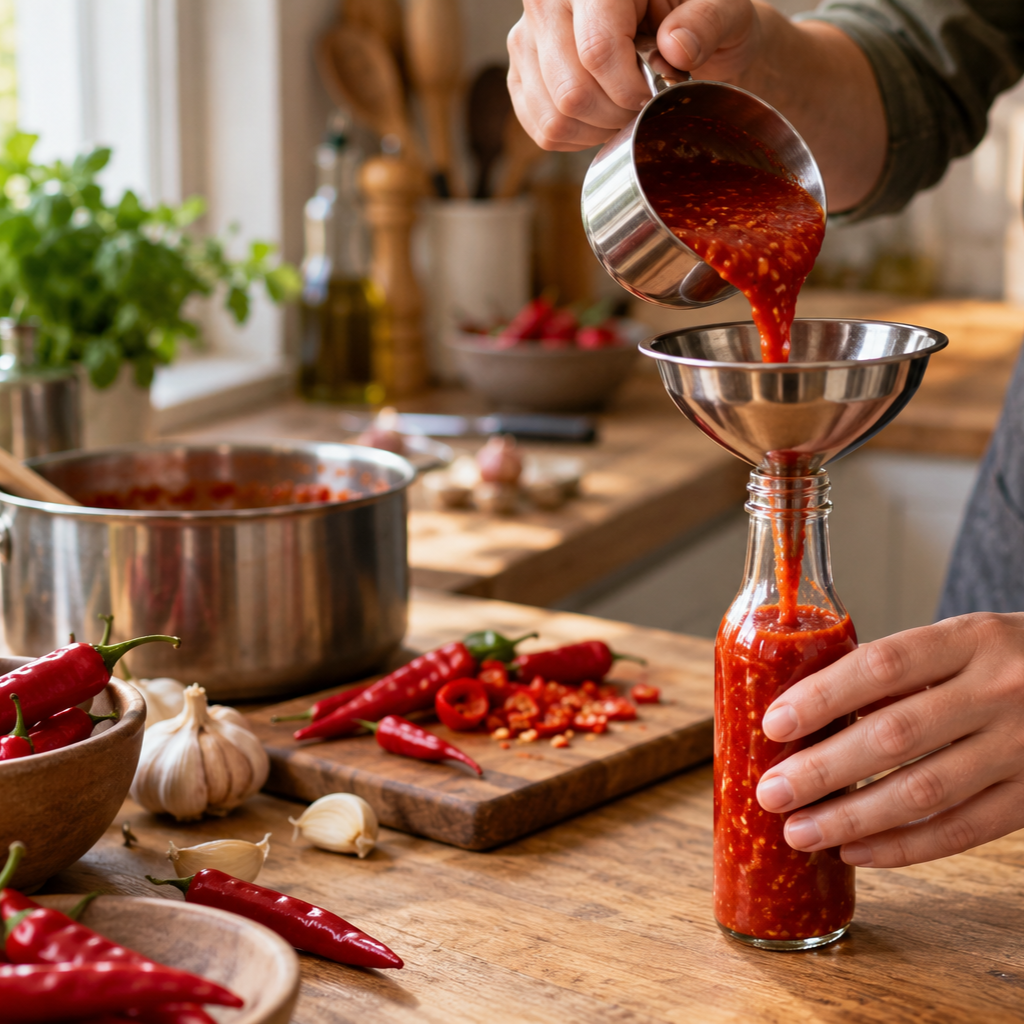
For a simple chilli sauce, chilli, peppers or tomato, vinegar, a little sugar and salt are cooked together and blended smooth. This basic recipe is meant as a first foundation that you can adapt however you like.
To make the sauce shelf-stable, salt and acidity need to be balanced correctly for your recipe and the sauce hot-filled. Then you can store the unopened bottles unrefrigerated for around 6 months.
Ingredients for about 500g of habanero chilli sauce
- 200g peppers
- 100g habanero chillies
- 150g ripe tomatoes
- 50g water (can be left out entirely at first, just to control consistency - the tomatoes already release a lot of water)
- 25g sugar or honey
Depending on the exact weight of your ingredients, calculate the weight of the following based on that total:
- 5% apple cider vinegar
- 2.5% salt
We use these same percentages as a starting point for our own sauces, to ensure shelf stability.
For a mild sauce, use mostly peppers and mild chillies.
Which chilli suits which sauce?
| Chilli | Flavour | Use |
|---|---|---|
| Jalapeño | green, herbaceous | mild green sauce |
| Cayenne | direct, clean heat | classic red sauce |
| Habanero | fruity and very hot | mango, apricot or citrus variation |
| Rocoto | juicy, thick-fleshed | bold cooked sauce |
| Superhot | extreme heat | only for careful dosing |
Our guide Chilli species explains the botanical and flavour differences.
Making chilli sauce
- Put on gloves, wash the fruit, remove the stems and roughly chop.
- Put all the ingredients in a pot and bring to the boil.
- Simmer gently, stirring, for about 15 to 20 minutes until soft.
- Blend very finely; with superhots, keep the lid closed and don't breathe in the fumes.
- Adjust the consistency with a little water or extra cooking time.
- Fill into very clean, heatproof bottles, let cool and chill straight away.
Controlling the heat
- Replace some of the chilli with peppers or tomato.
- Remove some of the inner membrane if you want less heat. The membrane is the hottest part of the pod.
- Add very hot varieties gradually. As we say here in Austrian dialect: "Eini geht's imma, aussa bringst as nimma" – roughly, "it always goes in, but you can never get it back out."
- Sugar and acidity change the flavour but don't remove capsaicin. You can use that deliberately to mask the heat (for example fruit-based sauces, or ones with more acidity...)
Balancing acidity, sweetness and salt
Vinegar brings freshness and affects microbial stability. Sugar rounds off bitterness, salt lifts flavour. Adjust in small steps and note down changes if you want to repeat the sauce. For new products, we do up to 20 iterations before a recipe is finished in terms of flavour.
Fixing the consistency
Too thick: add water or vinegar a spoonful at a time. Too thin: keep simmering uncovered. For a smooth sauce, pass it through a fine sieve; for a rustic texture, only blend briefly. Starch usually isn't needed and can change the texture during storage. With us, everything always goes in, by the way - seeds and flesh - and it's then blended fine. You can also strain sauces if you want that consistency.
Variations
The basic recipe is meant as a starting point for you. You can swap out pretty much any ingredient. What matters most is the flavour that each ingredient is meant to cover. You always need to bring fruit, heat, acidity, salt and sweetness into the balance you want. Here's the quick overview:
Fruit: peppers/no peppers, tomato/carrot, or fully fruity with mango/pineapple/papaya/apricot/apple/banana/and more
Heat: mild/medium/hot/superhot chilli variety
Acidity: apple cider vinegar/balsamic/white vinegar/white wine vinegar/lemon juice/lime
Sweetness: sugar, honey, maple syrup, muscovado sugar, agave syrup, xylitol
Fruity
Replace some of the tomato with mango, apricot or pineapple and re-balance the acidity.
Smoky
Use dried chipotle or smoked paprika. Grill or roast the ingredients first. We explain what chipotle is here.
Fermented
Fermentation is its own process with a controlled salt concentration in the mash. This recipe uses only fresh ingredients. Different rules apply for fermentation, which goes beyond the scope of this guide.
Just try things out. There are countless possibilities and variations!
Storage
- After boiling, hot-fill, seal and let cool upside down.
- Only ever use clean utensils to serve, and keep the bottle rim dry.
- Small bottles mean less frequent opening.
- You can tell the sauce has gone off by two main signs - then it needs to be discarded.
- It hisses - the sauce has started to ferment (careful: this can also happen in summer straight from the fridge if you leave it outside - the air expands in the heat and hisses too).
- It's mouldy - mould has taken over
FAQs
How long does homemade chilli sauce keep?
About 6-8 months unopened. After opening, store in the fridge and use up within 2 weeks.
Can I can the sauce?
Yes, you should fill the sauce in while hot - ideally still boiling - and seal it right away. The salt and acidity here are already adjusted for stable storage.
What do I do if the sauce is too hot?
In theory, dilute it with a second, mild sauce without chilli. Directly in a dish, more base ingredients and a smaller portion help. In our experience, really the only thing that helps is using less of the sauce.
You'll find more processing methods in our chilli harvest hub. Ready-made sauces from chillies grown by us are in our hot sauce collection.