

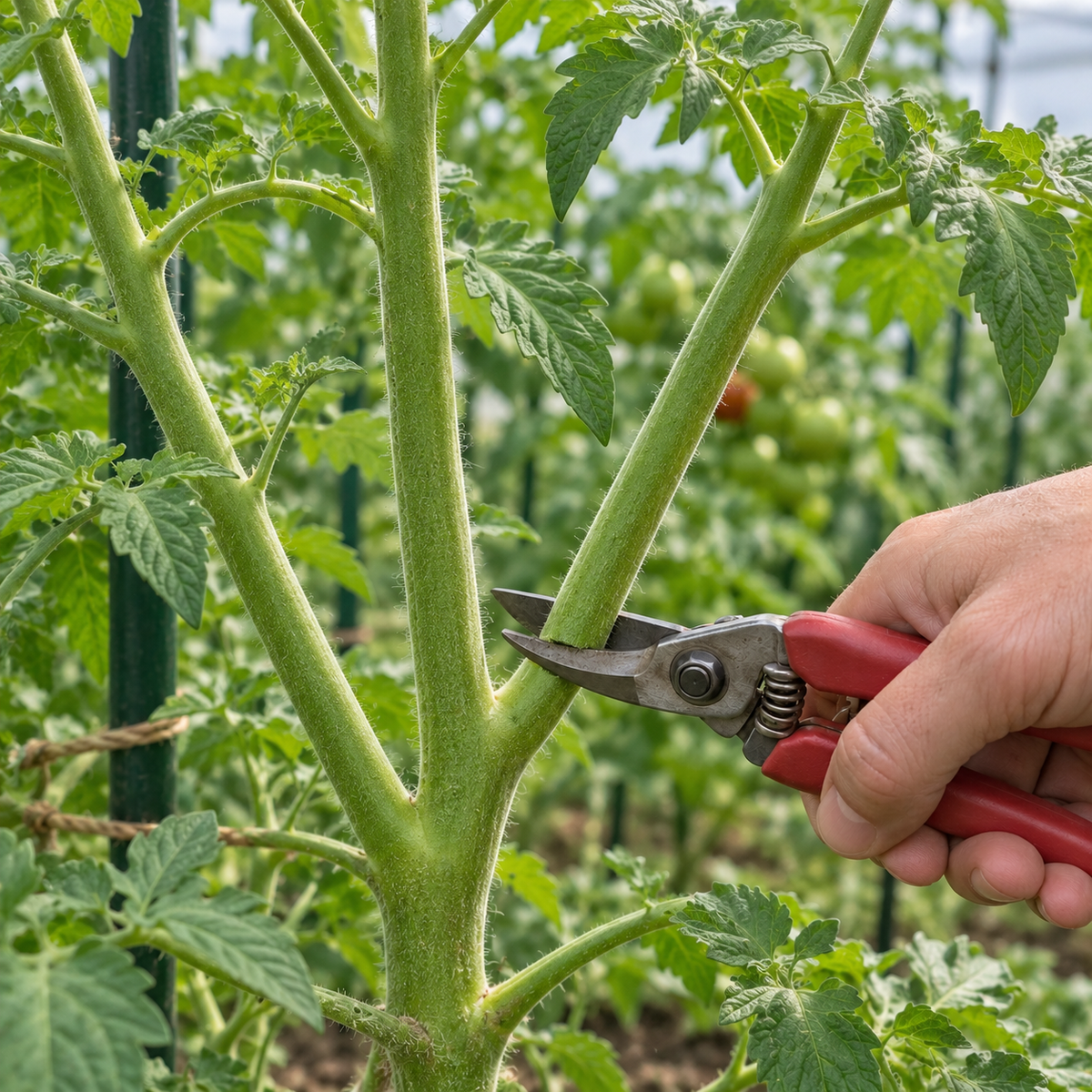
"Pruning" is easily confused with pinching out side shoots when it comes to tomatoes, but it means something different - and a lot of people, unsure which is which, either don't prune at all or go at it far too hard. Here in Illmitz, we bring thousands of plants into shape in a controlled way every season, so we know exactly where the line sits between useful pruning and an unnecessary cut.
Pruning is not the same as pinching out side shoots
Pinching out side shoots means removing the small shoots in the leaf axils before they become full side branches - exactly how to do that is covered in detail in our guide to pinching out side shoots. This article is about the steps that come after: deliberate cuts to parts of the plant that have already grown, which let you actively steer your tomato's yield and health.
Growing on two leaders: more yield with the right technique
One decision that's closely tied to pinching out side shoots, but is really its own bit of shaping: instead of stubbornly sticking to a single main stem, you can deliberately let a second shoot grow on - what's known as growing on two leaders. Alongside the main stem, exactly one strong side shoot is kept - usually the one directly below the first flower truss - while all the other side shoots are removed as usual.
The advantage: two leaders carry more flowers and so potentially more fruit than one alone, without the plant sprawling completely out of control the way it would if you skipped pinching out side shoots altogether. The downside: both leaders still share the same root system and nutrient supply, so the individual fruit tends to come out a little smaller than with a single-leader plant.
We use the two-leader method here in Illmitz mainly on vigorous, high-yielding varieties like our San Marzano - for more compact patio tomatoes, the extra effort usually isn't worth it. Important: decide on the second leader early and clearly, or you'll quickly lose track of which side shoot is meant to stay and which needs to go.
Why lower foliage should be removed
We deliberately remove the lowest leaves, closest to the ground, from our plants as the season goes on. They contribute little to photosynthesis once the plant has grown taller, but they raise the risk of fungal diseases like blight, since they're often in contact with damp soil. As a rule of thumb, we remove all leaves below the first ripening fruit truss.
Topping the main stem - only at the right time
About 4 to 6 weeks before the expected end of the season, usually in August, we top the tip of the main stem on tall-growing cordon tomatoes. This stops further height growth and directs the plant's remaining energy specifically into ripening the fruit that's already there, rather than into new flowers that wouldn't ripen in time anyway.
Remove diseased or damaged parts immediately
If a leaf or shoot shows signs of disease, such as the typical spotting of blight, we cut it out straight away - even if it still looks green and healthy. That gives the rest of the plant the best chance of being spared. You'll find more on the most common disease patterns in our guide on tomato diseases.
The right tool
Use clean, sharp secateurs or a knife for every cut - blunt blades crush the tissue instead of cutting cleanly, which makes it easier for pathogens to get in. If we suspect a fungal disease, we disinfect the tool between plants so nothing spreads unnoticed.
A sturdy plant forgives more
As with pinching out side shoots, the same rule applies here: a plant that's strong and healthy from the start copes with pruning far better than one that's already weakened. Our young tomato plants reach you already robust and well developed - the best possible starting point for any pruning still to come over the course of the season.